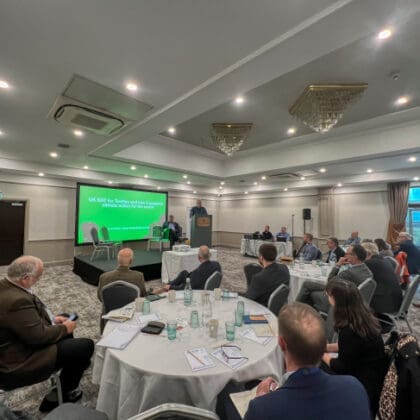
SDC UK Coloration and Finishing Conference
by Andrew Filarowski, Technical Director, SDC
2 November 2023
On 2 November over 100 people gathered for the first SDC UK Textile Coloration and Finishing Conference to hear selected keynote speakers and panel members discuss the issues affecting the UK textiles industry — specifically in the areas of wet processing.
The SDC received a letter of support from HRH Princess Royal, HRH The King also sent his warmest wishes to all at The Society of Dyers and Colourists.
Sponsorship was from The Worshipful Company of Dyers, Dystar, BTMA, CHT UK Ltd, SDC Enterprises and Advanced Colours and Chemicals/ Wilkinson and Scott.
The guest charity was Fashion and Textiles Children’s Trust https://www.ftct.org.uk
Over 30% of the UK textile wet processing companies were represented in the audience and almost 50% had responded either positively to attend or to give their apologies.
Another aspect to report is both the gender and age demographic of the audience.
Gender
- Males 78%
- Females 22%
Age Range
- 18 – 24 2%
- 25 – 34 20%
- 35 – 44 10.5%
- 45 – 54 27%
- 55 – 64 29%
- 65 + over 11.5%
With a 22% female audience going some way to prove the feeling that more females are involved in the technical aspects of textile processing than ever before, and this trend is growing.
The age ranges represented in the audience also shows a healthy influx of young people in the industry and that companies are providing them with an opportunity to network and learn by attending such events. The number of young people who have been or intend to be on SDC educational courses shows the benefit of these to the UK industry.
The event was introduced by the SDC’s current president, Professor Chris Carr CCol FSDC, who presented the keynote speaker Patrick Grant who gave us an overview of his career in textiles with the takeaway being that everything is possible through collaboration, education and skill.
Paul de Beer, our moderator for the day then introduced the first speaker, Spence Seaman from the Environment Agency who spoke about the open peer review currently taking place on the UK BAT. This will bring revised and updated standards across the sector and introduces mandatory Emission Limit Values (ELVs) across sectors. It also provides best practice for the management of inputs and outputs within the manufacturing sector. Spence made the valid point that this should involve all UK wet processing plants whether operating under a permit or not as it does provide best practice that should involve all companies to reduce out puts to air and water.
He called on the industry to come together potentially with the help of the SDC to ensure the peer review process covers all aspects of the industry and is disseminated to provide clear guidelines and effective implementation. He finished with coverage of the aims of the UK government to build climate resilience through a combination of mitigation and adaptation to reduce emissions that cause climate change and have actions in place to manage the risks of climate change aspects.
Spence Seaman was then joined on a panel by Mike Madden from Enco Global Testing Services, Anna Govey, Director responsible for Quality, Health, Safety and Environment at Heathcoat Fabrics and Parasjevi Fotoglou, Sustainability Manager at Camira Fabrics to discuss first how the implementation of the UK BAT can be effectively managed and how each company is working towards managing its inputs and outputs in respect of current and future legislation.
Anna Pangbourne, Chief Executive of the Fashion and Textiles Children’s Trust also provided us with an overview of how companies can interact with the charity so its employees can benefit from their help and well as supporting the charity in its work.
The theme of net zero continued with a close look at how one company has used technology to identify and reduce its energy usage. Wet processing operations are very energy intensive, requiring large amounts of hot water and steam alongside a substantial amount of gas and electricity. Many companies do not have the visibility across their energy consuming assets to prove this or take corrective actions.
Maciek Zyga, Head of Engineering at Amann Threads UK was joined by Stephen Kay and Peter Catlow from Businesswise Solutions Ltd to describe the technology used to identify energy usage throughout the organisation. Maciek explained how they have implemented the technology throughout the business both the identify low hanging fruits as well in more challenging situations and the effect this has had on energy use and therefore emissions. Giving full costings he identified this as a cost-effective way to manage this situation. He explained that he now had access to data on how much each piece of equipment consumes on a minute-to-minute basis to be able to identify opportunities to improve efficiencies and reduce waste in real time.
In the panel session they were joined by Louise Becart, Business Strategy Analyst at Pincroft Dyeing and Printing Ltd. Louise explained how the company had placed sustainability and operating efficiency at the heart of its dyehouse operations. They too have used a system to monitor their operations. This led to the installation of a heat recovery plant recovering waste heat from waste water and atmospheric releases to heat clean process water and identify when it is being used correctly. Louise also explained why Pincroft had taken the decision to install a 1.2 MW combined heat and power plant (CHP), what benefits this has had and what payback for this installation is. Audience participation was key to this session with many delegates keen to understand more and to praise both companies for the investments they are making in this area.
David Tindale, Chief Technical Officer of Adaptive Control Systems Ltd then gave a talk on Automation, Integration and Visualisation – What’s New and What’s Not. David gave an overview of the start of process controls systems with Beacon Controls and how the systems had progressed to be Windows based allowing better adoption and user-friendly interfaces that are common in systems. System analysis available 24/7 of a wide range of processing parameters can lead to better control and efficiencies within a dyehouse.
The panel session included James Blackburn CCol ASDC, Commercial Manager at FTS Dyers and Amanda McLaren, Managing Director of AW Hainsworth and Sons Ltd. James gave an overview of how updating their control systems had benefited the company. Amanda used the acquisition of Atkinson Dyeing Company Ltd as a case study explaining how both upgrading machinery both in their positions and the installation of a modern control system had not only had a positive effect on process optimisation and control through feedback systems but had also had a positive impact on how employees’ attitudes had changed and positively impacted the business.
The final session involved Andrew Filarowski, Technical Director at the SDC, Martin Jenkins, Director of Training at HCoE and Jason Kent, CEO of BTMA. The topic was centred around the need to encourage young people to join the sector and the opportunities that exist for young people both educationally and as long-term careers. Jason gave an overview of a recent apprenticeship in textile machinery engineering that BTMA have supported and Martin an overview of the various apprenticeships available with Andrew providing an overview of the educational opportunities for young colourists through the SDC educational programmes.
The consensus was that collaboration between the various sectors within textiles was taking place but potentially more was required both in interactions with schools and careers advisors and session to highlight the opportunities. Various companies in the audience gave examples of their involvement in building the profile of the industry and there was an interesting comment form a recent entrant to industrial processing from a design background who highlighted they had never in their time at school or University been informed of the opportunities within textile manufacturing.
All agreed that action needs to be taken and where coloration is concerned individual actions are possible but potentially the SDC could take a lead nationally.
The vote of thanks was from Jamie Cawley, Prime Warden of The Worshipful company of Dyers, who had provided funding for the conference. He commented how it was encouraging to see the industry come together to share best practice for the improvement of the UK coloration and finishing industry.
Paul de Beer closed the conference with the following points:
- Collaboration is key to ensure the industry flourishes.
- Engagement with the Environment Agency but all companies in the peer review process could be through the SDC and involvement by all companies was important to ensure this regulation was well written.
- Young people are the lifeblood of the industry in the UK and globally. The opportunities for education through the SDC should be taken up by all companies.
- Collaboration in highlighting the industry to young people is key.
- Dialogue within the industry should continue and he hoped that the SDC would hold another conference in 2024.
The organising committee have now met, and the second UK Textile Coloration and Finishing Conference will take place on 3 October 2024.