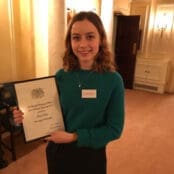
“Dyehouse apprentice Gemma Rudd, who works in Production Technical Support for Atkinson Dyeing in Keighley, West Yorkshire, UK, is nearing the end of her first year of study for the Textile Coloration Certificate (TCC) with the SDC.
In our latest blog, she talks about her job, her studies, and her passion for the application of colour to fibre.
What brought you into the dyeing industry?
Before joining the dyeing industry I worked for a fast fashion company as their colour and fabric coordinator. As a part of my role, I created seasonal colour pallets with the design teams. It was my job to communicate colour information and standards within the business and also to external suppliers and dyehouses.
This work involved very little technical colour knowledge, and left me at a disadvantage when wanting to communicate with suppliers and dyers.
Being made redundant, due to the pandemic, gave me the opportunity to re-evaluate my career path and re-educate myself in what I’m truly passionate about – which is the application of colour to fibre. Studying with the SDC has allowed me to move from design into a technical role within the industry.
How did you find out about qualifications at the SDC?
Having come across the SDC during my time at university, I attended a speed mentoring event held by the London region before later joining the committee.
My redundancy gave me the motivation to put myself forward for the FTCC. Following a an encouraging conversation with Andrew Filarowski, technical director at the SDC, I was certain that studying for the FTCC and then the SDC would be a positive step forward in my career.
I later secured my new role with the technical team at Atkinson Dyeing – which is owned by A W Hainsworth. While working here I have continued my education with the SDC.
How long have you been studying with the SDC?
I have completed the FTCC and am now within the first year of the TCC.
How do you find the learning environment – does this suit your learning style?
Learning online gives me the flexibility to fit lectures around my role at Atkinson. This has allowed me to combine theory with practical learning on the job.
Has the course content been applicable to your role? Have you been able to implement your learnings within your role?
Yes the course content has been applicable to my role – and my learnings have helped me solve problems within the work place.
What is your favourite/most useful/ mot enlightening thing that you have learned?
The most enlightening thing I’ve learnt from the SDC and through my colleagues within the dyeing industry is that every problem can be solved through research and a willingness to learn.
How has earning while you learn benefited you?
It has allowed me to put my knowledge and learning into practice, resulting in a deeper understanding of my role within the team at Atkinson Dyeing.
It has given me the confidence to work independently, knowing I have the knowledge to overcome any problems that arise.
Has obtaining the qualification progressed your career so far?
Studying for the FTCC and gaining the qualification made me stand out as a candidate when I was accepted for my current job.
Knowing I had taken the initiative to improve my technical knowledge before joining the company gave them confidence in my willingness to progress with them. Currently studying for the TCC has further progressed my technical ability and confidence tremendously within my current role.
How do you feel your qualification with the SDC has improved your career prospects?
I feel my current qualifications with the SDC have improved my personal career prospects massively. It has given me a goal and a focus educationally – as well as providing a structure within my role.
What are your ambitions for the future?
I would like to go on to study the ASDC and would like to become a Chartered Colourist.”
Gemma Rudd